This Odessa EV charger installation case study walks through the real diagnosis, the fix, and the code details from a recent service call. A homeowner in Odessa, FL reached out wanting to put their existing 60A garage circuit to work — this time for a Ford Mustang Mach-E instead of the Tesla the previous owner had used. The plan was straightforward: confirm the circuit was still serviceable, hardwire a Tesla Universal Wall Connector, and add an energy meter to enable Dynamic Power Management. What our field team found during the visit gave the family a much clearer picture of where their home stood — and what it would take to keep everything running smoothly for years ahead.
The Problem
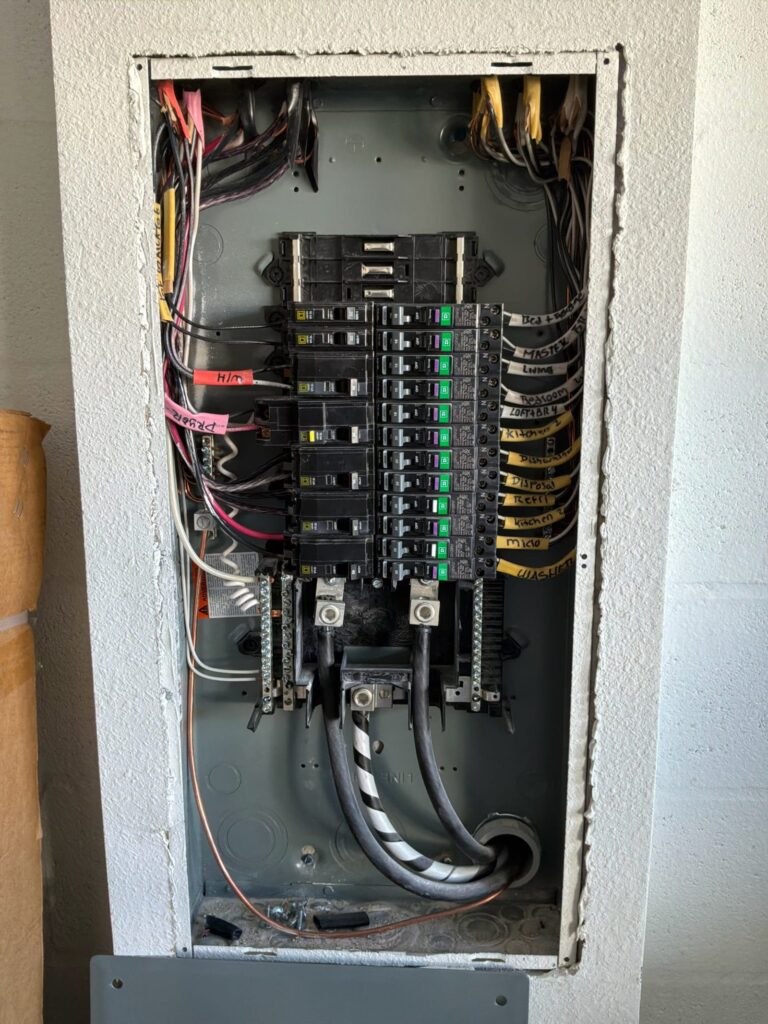
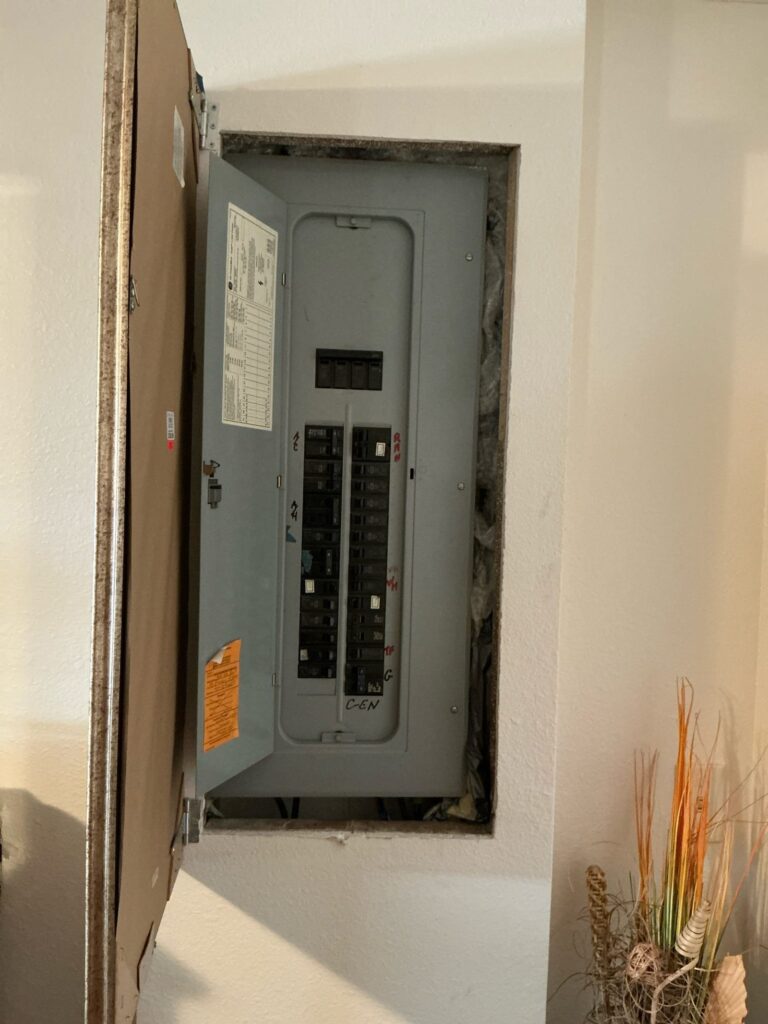
The homeowner had inherited a 60A EV circuit from the previous owner. The breaker was off, the conduit run from the 150A Siemens panel to the garage junction box was in place, and the new EV charger was ready to go. Before anything could be energized, though, our team needed to verify the circuit was intact and properly sized for the new connector.
“I need service to confirm that the existing 60A circuit is usable and hardwire my Tesla Universal Wall Connector to the existing junction box. Then install an energy meter to enable Dynamic Power Management to avoid a panel upgrade.”
Investigation
Our technician on-site started with the 60A circuit — tracing the conduit run, checking terminations at the junction box, and confirming the breaker in the Siemens 150A panel was correctly sized per NEC 625.41 for EV charging loads. The circuit checked out: conductors were properly sized, the conduit was undamaged, and the junction box was accessible.
Additionally, the team performed a full visual safety inspection of the home’s electrical system — the kind of walkthrough that often surfaces things a new homeowner hasn’t had a chance to address yet.
Panel and Branch Circuit Findings
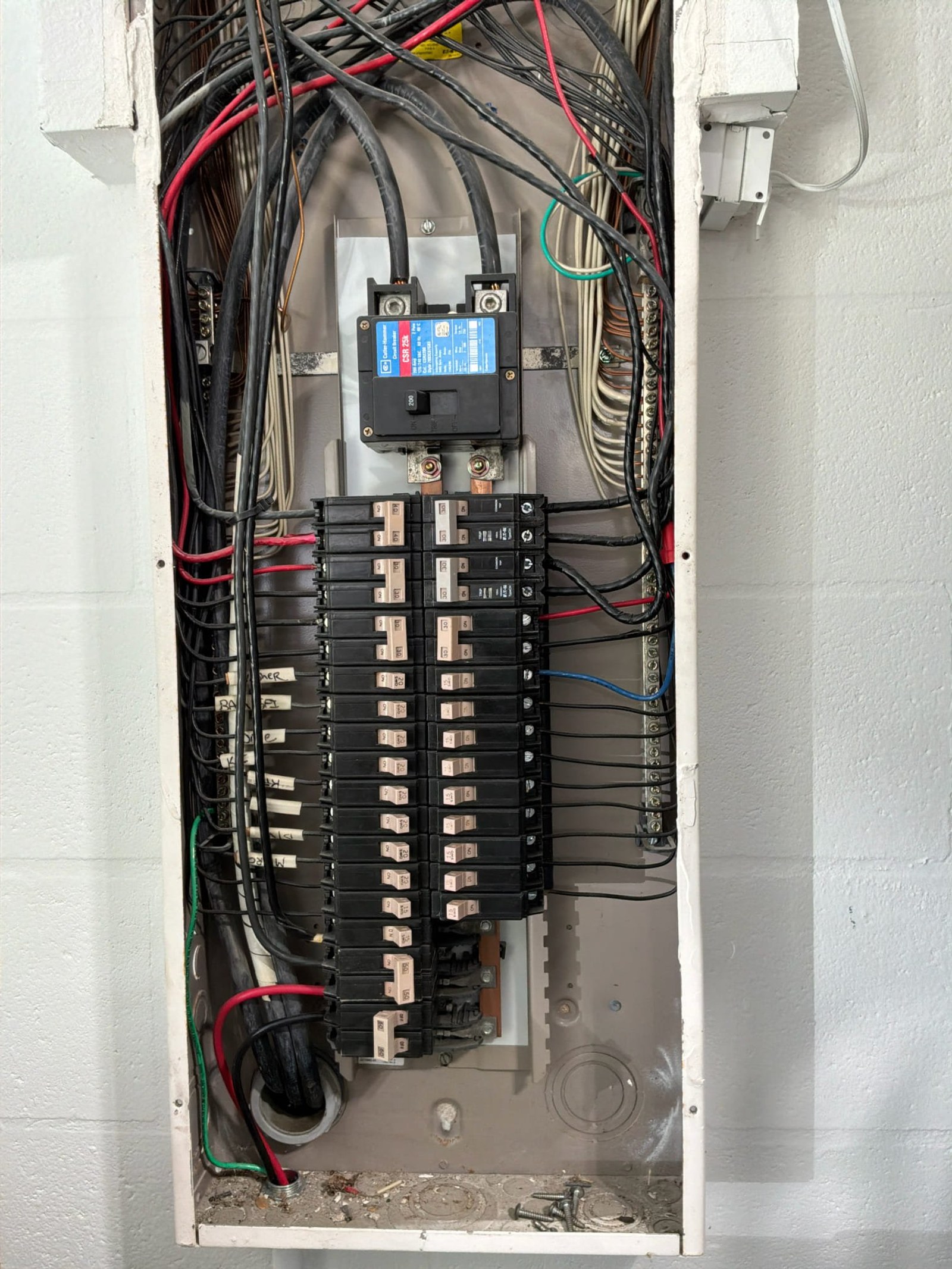
The inspection revealed double-tapped breakers inside the Siemens panel — a condition where two conductors share a single breaker terminal not rated for it. Over time, that uneven clamping leads to loose connections and the intermittent performance issues it causes. The panel directory was clearly labeled and the main breaker was properly sized, but the double-tap condition was flagged for correction.
The grounding system passed its core checks — neutrals and grounds were properly separated, the grounding electrodes were present, and outlets tested as properly grounded. However, the grounding system showed one area worth a closer look, and the inspection also noted some corrosion on service components — consistent with Florida’s coastal humidity and worth monitoring.
Outlets, Switches, and Backstabbing
The home’s receptacles showed a pattern common in houses wired before roughly 2005: backstabbed connections. Rather than securing conductors under a screw terminal, installers pressed wires into spring-loaded holes on the back of the device. It’s faster during construction, but the spring tension loosens with the heating and cooling cycles every outlet goes through daily. The result is rising contact resistance, intermittent behavior, and the kind of low-level flicker or non-response that’s easy to dismiss. Replacing backstabbed devices with proper screw-terminal connections is one of the more durable improvements a homeowner can make — per NEC 110.14(B), terminals must make reliable, lasting contact.
The inspection also noted that tamper-resistant receptacles were not consistently present throughout the home. Current code under NEC 406.12 requires tamper-resistant receptacles in all dwelling-unit locations — a straightforward upgrade when devices are being replaced anyway.
Life-Safety Devices
No smoke detectors or carbon monoxide detectors were found in the home. Under NFPA 72, interconnected smoke and CO detection is required in all dwelling units — so every room hears the alarm if any one detector triggers. Similarly, AFCI protection was absent on the branch circuits; NEC 210.12 now requires arc-fault protection on virtually all living-area branch circuits in a dwelling.
No whole-home surge protective device was present. With a 60A EV charger, central AC, and everyday electronics all drawing from the same 150A service, a Type 2 SPD at the panel — required for new dwelling-unit services under NEC 230.67 — is one of the most cost-effective ways to protect everything plugged in.
What We Fixed
Our crew confirmed the existing 60A circuit was fully serviceable. We hardwired the Tesla Universal Wall Connector to the garage junction box and installed an energy meter to support Dynamic Power Management — allowing the charger to modulate its draw based on whole-home load, so the existing 150A Siemens panel can handle EV charging alongside the home’s other demands without requiring a service upgrade.
Beyond the EV work, the team documented all inspection findings and presented the homeowner with clear options for addressing the double-tapped breakers, backstabbed devices, missing smoke and CO detectors, absent AFCI protection, and the recommendation for a whole-home surge protector.
Why This Odessa Ev Charger Installation Matters for Homeowners
For a family settling into a home someone else wired, a full walkthrough like this one is one of the best early investments they can make. Not because anything was wrong in a dramatic sense — most of what we found was simply consistent with how homes of this era were built — but because knowing the full picture means nothing sneaks up on you later.
The Dynamic Power Management setup is a good example of reliability working quietly in the background. Instead of worrying whether charging the Mach-E overnight will push the panel past its comfort zone, the energy meter handles that calculation automatically. The family gets a full charge every morning without ever thinking about it.
Meanwhile, interconnected smoke and CO detectors mean every part of the house is aware of every other part — so if anything ever changes in the middle of the night, the whole household knows immediately. That kind of peace of mind doesn’t require a panel upgrade or a major project. It just requires getting the right devices in the right places. Our team is licensed under Florida EC13015487 and all work is performed to current NEC standards — so the family can verify our credentials and move forward with confidence. Learn more about home electrical safety from the Electrical Safety Foundation International.
Code Compliance Cited in This Job
Every fix above maps to a specific section of NEC 2023. Each card links to NFPA’s public NEC index.
EV Charging Branch-Circuit Ampacity
NEC 625.41 governs the ampacity requirements for EV charging branch circuits. On this job, we verified the existing 60A circuit — conductors, breaker, and conduit — met the continuous-load rating required for the Tesla Universal Wall Connector before energizing the circuit. NFPA reference ›
Surge Protective Device at Service
NEC 230.67 requires a surge protective device at the service entrance of new and upgraded dwelling-unit services. The Siemens 150A panel lacked any SPD, leaving the home’s electronics, appliances, and newly installed EV charger without panel-level surge protection — an opportunity for improvement we documented for the homeowner. NFPA reference ›
AFCI Protection for Dwelling Branch Circuits
NEC 210.12 requires arc-fault circuit-interrupter protection on branch circuits supplying outlets in virtually all living areas of a dwelling unit. The inspection found no AFCI protection present on the home’s branch circuits, which predates the current code cycle’s expanded AFCI requirements. NFPA reference ›
Electrical Connections — Terminal Requirements
NEC 110.14(B) requires that conductors be terminated in a manner that ensures reliable, lasting contact. The backstabbed receptacles found throughout this home rely on spring-clip retention rather than screw-terminal clamping — a method consistent with pre-2005 construction practice but one that current code and best practice have moved away from. NFPA reference ›
Tamper-Resistant Receptacles in Dwellings
NEC 406.12 requires tamper-resistant receptacles throughout all dwelling-unit locations. The inspection noted that tamper-resistant devices were not consistently installed — standard for the home’s era, and straightforward to address when outlets are being replaced for other reasons. NFPA reference ›
Circuit Directory and Identification
NEC 408.4 requires that every circuit in a panelboard be legibly identified. The Siemens panel’s directory was clearly and accurately labeled — one of the easier wins that makes future troubleshooting and service calls faster and more reliable. NFPA reference ›
Common Questions
Questions homeowners ask after seeing this kind of work.
Can a Tesla Universal Wall Connector be used to charge a Ford Mustang Mach-E?
Yes — the Tesla Universal Wall Connector includes a J1772 adapter, which is compatible with non-Tesla EVs including the Ford Mustang Mach-E. When hardwired, it delivers up to 48A of continuous charging current, which fully replenishes most EVs overnight. If you’re switching vehicles or moving into a home with an existing Tesla charger, our team can confirm compatibility and get you set up. Schedule online to arrange a same-day assessment.
What is Dynamic Power Management on an EV charger, and do I need an energy meter for it?
Dynamic Power Management allows the charger to monitor whole-home electrical load in real time and adjust its charging rate so it doesn’t push the panel past capacity. An energy meter installed at the panel feeds that load data to the charger. It’s a practical alternative to a panel upgrade when an existing service has enough headroom but not a lot of margin to spare. If you’re wondering whether your current setup can support EV charging without a service upgrade, book a quick consultation and we can run the numbers.
What are double-tapped breakers, and why do they matter?
A double-tapped breaker has two separate conductors landed on a single terminal that was designed for one. Unless the breaker is specifically listed for two conductors — which most are not — one wire will always have less clamping force than it needs. Over time that loose connection generates heat and can cause intermittent tripping or unreliable circuit performance. It’s one of the more common findings in homes that haven’t had a panel inspection recently. Schedule a panel walkthrough and we’ll document exactly what’s inside yours.
How often should I have my home’s electrical system inspected?
Once a year is a reasonable baseline for most homes. Older homes built before 1990 — and homes that have been through recent storms — often benefit from inspections more frequently, since aging components and weather events can accelerate wear in ways that aren’t visible from the outside. A yearly inspection keeps small findings from turning into larger projects. Book your annual inspection and we’ll walk through the whole system with you.
Is a whole-home surge protector worth adding if I’m installing an EV charger?
It’s one of the most practical additions you can pair with an EV charger install. A Type 2 surge protective device at the panel, per NEC 230.67, absorbs voltage spikes from lightning and grid events before they reach your charger, appliances, HVAC, and electronics. With a high-value load like an EV charger on the circuit, the cost of the SPD is modest compared to what it covers. Schedule online to add surge protection to your next electrical service visit.
Want to see more real jobs like this one? Browse our completed case studies or explore our services.